
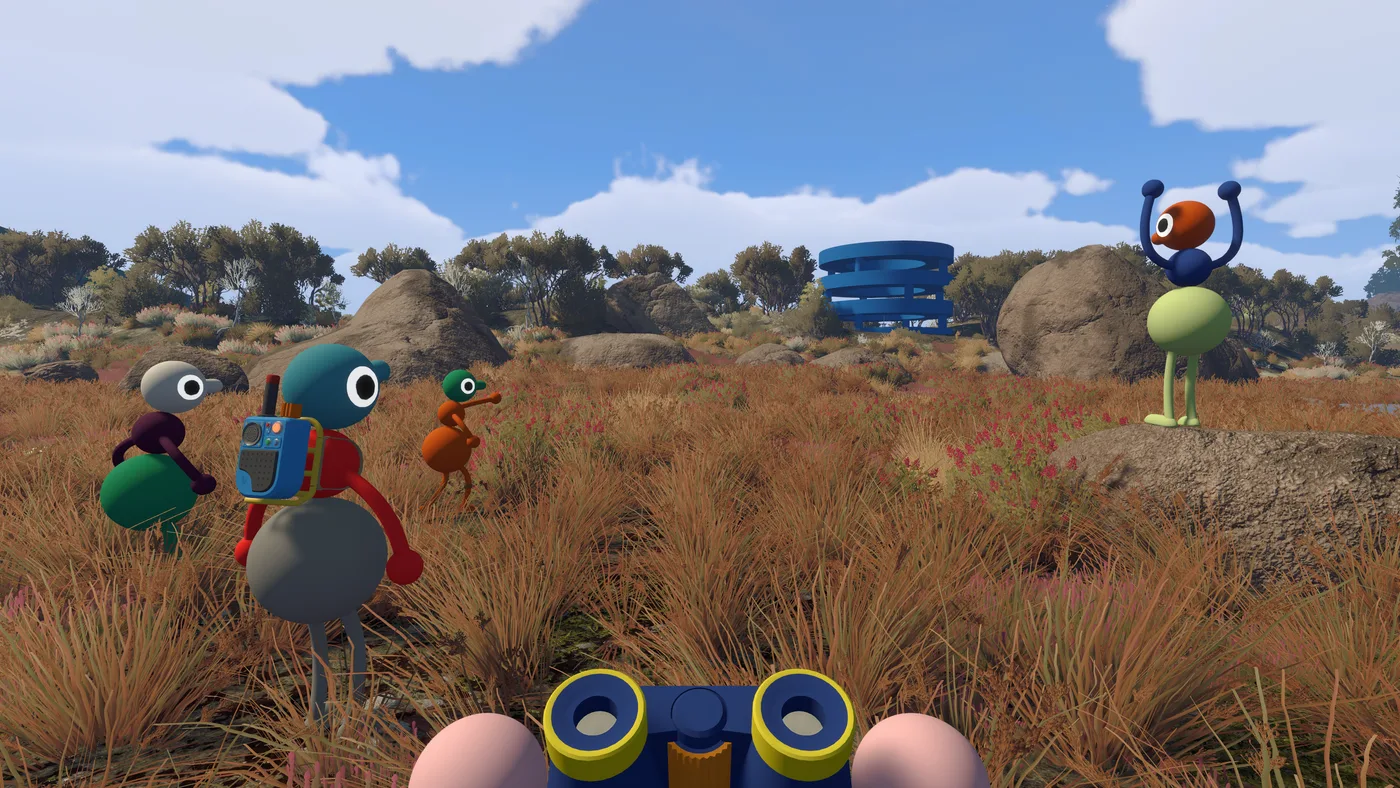
Binoculars are the only item in Big Walk’s tool list that appears twice in official material. They are in the press kit’s “Tools and Toys” line, and they turn up again in the Steam store description — not as a feature, but as a joke about what you can do to your friends: “Sit and watch the sunset, or steal your friend’s binoculars and kick them into the ocean.”
That second mention is more informative than the first, because it establishes something the feature list does not: tools are physical objects that can change hands against their owner’s wishes.
What is confirmed
- They are a carried object. From the stealing line — you can take a pair off another player.
- They obey physics. They can be kicked into the ocean, which means items are objects in the world rather than abstract inventory entries.
- They can change hands against the owner’s will. Possession is a live piece of group state, not a setting.
- They are for looking at distant things. By definition of the item; House House add nothing.
Not published:
- Zoom level or effective range.
- Whether they mark, tag or highlight anything for other players.
- Whether they interact with the laser pointer, which solves the adjacent problem of showing others which distant thing you mean.
- Whether what one player sees can be shared in any way other than describing it out loud.
The one adjacent fact worth knowing: House House confirm that “some items in the game can improve accessibility, such as highlighting interactive items.” They do not say which items, and binoculars are the obvious candidate — but that is inference, not a published link.
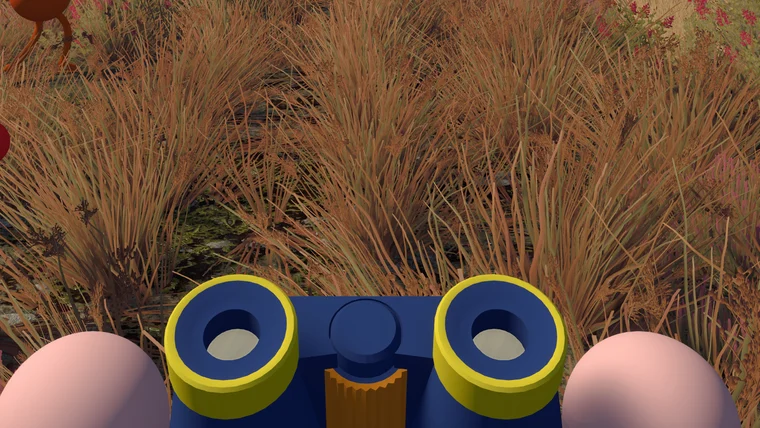
Why the stealing line matters
Most co-op games treat shared items as a resource-allocation problem. House House put a sentence in their own store copy about ruining a friend’s afternoon with one, which tells you the intended register.
It also has a practical consequence for a group planning a session. If tools can be taken, dropped and thrown, then “who is carrying the binoculars” is a live piece of state rather than a setting. In a game where the world is a wide-open bushland and every granite outcrop resembles every other one, the person doing the looking is doing real navigational work — and the same physics that let them be handed over let them end up at the bottom of the ocean.
The related tool is the laser pointer, which solves the other half of the same problem: binoculars let you see the thing, and a laser pointer lets you show everyone else which thing you mean. Neither is documented as interacting with the other, but they are the two confirmed items addressing “that one, over there” — the question this game’s landscape asks constantly.