
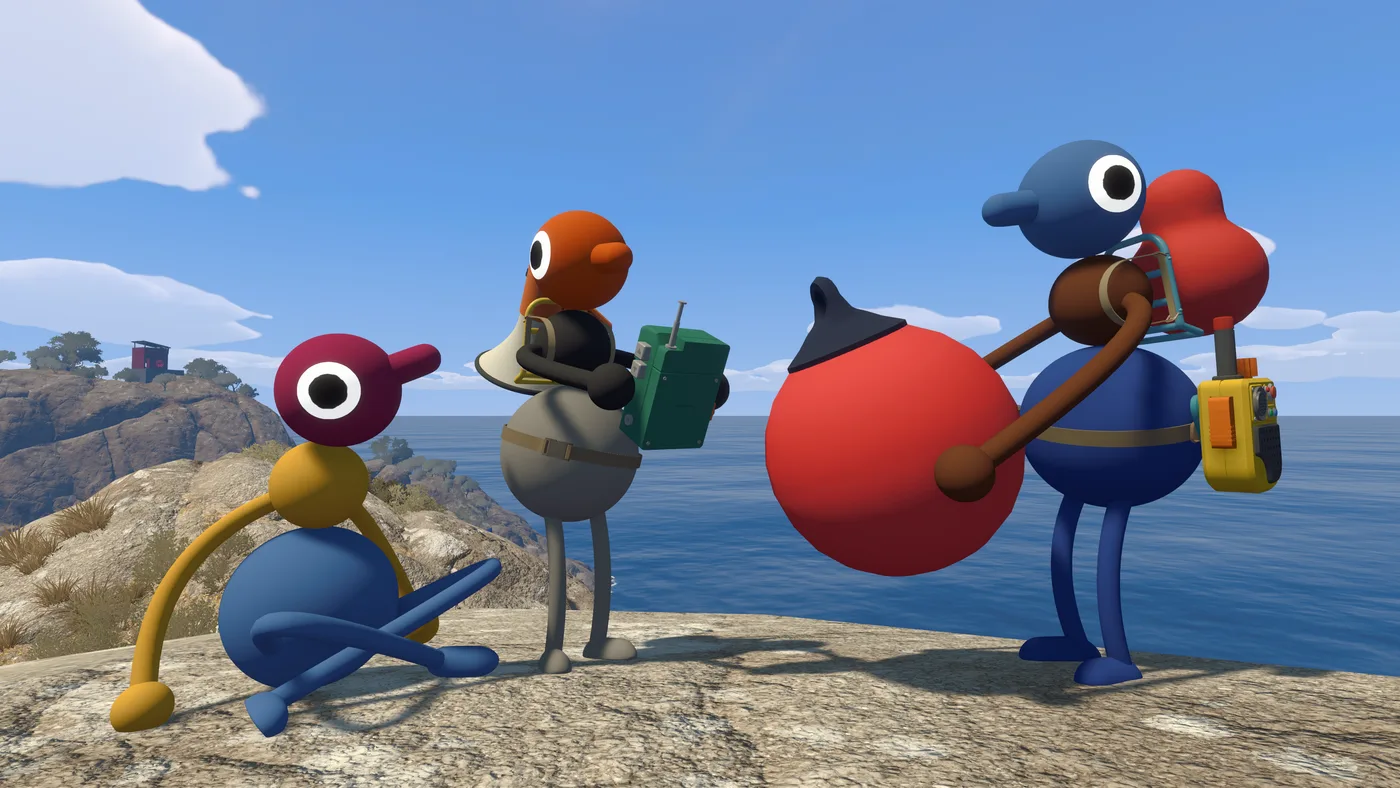
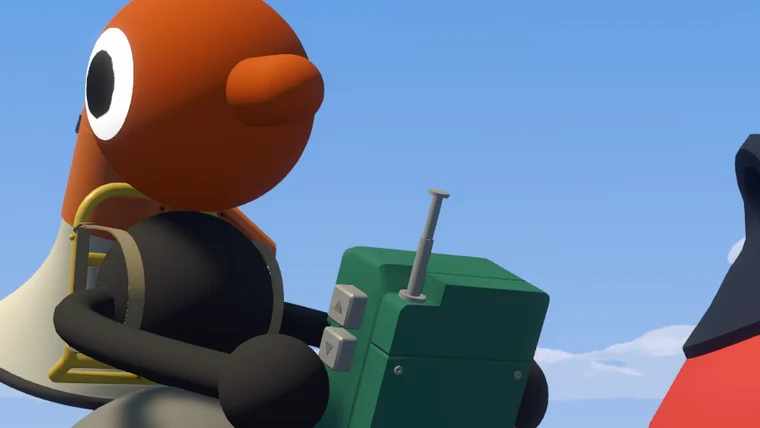
The walkie-talkie appears in every piece of official material House House has put out about Big Walk’s communication systems. It is the first item in the press kit’s “Tools and Toys” line, and it is the one example named in the description of the proximity voice system itself: voices “fade across distances, echo down corridors, muffle through walls, and crackle through walkie-talkies.”
That last clause is the whole mechanic. Proximity chat has a range; the walkie-talkie is how you talk to someone outside it. Everything about how a group spreads out across the world follows from who is holding one.
What House House has confirmed
Three things are stated in first-party material, and they are worth separating from the guesswork circulating elsewhere.
It carries voice beyond proximity range. The press kit lists it among the tools you use to “stay in contact” while finding your way around an open world at your own pace. Distance is the constraint the walkie-talkie removes.
Transmitted voice sounds different. The official description says voices “crackle through walkie-talkies” — the radio filter is a deliberate audio treatment, not a neutral pipe. In a game where you identify who is talking by ear, that colouring is information: it tells you the person is somewhere else.
Text chat works through it too. The official FAQ is explicit: Big Walk’s in-game text chat “has the same features (and intentional limitations)” as voice, and gives the walkie-talkie as an example — “your text chat will work with in-game items like walkie talkies.” A player typing instead of speaking gets the same extended range from the same item.
Why it changes how you move
Big Walk is a wide-open world you cross together at walking pace, and the game is built around groups splitting up and finding each other again. Without a walkie-talkie, splitting up means going silent — you get whatever proximity chat still reaches, which fades fast and is blocked by walls entirely.
With one, a scout can go ahead and keep narrating. That is the difference between “we lost Sam” and “Sam is at the tower, come left at the rocks.” It also changes what the game can do to you: House House built situations where you “suddenly find yourself speechless” and have to find another way to communicate. A radio in the group is one of the things those situations are designed around.
Practical consequences for a session, all following from confirmed behaviour:
- The person most likely to wander should be carrying one, not the person most likely to stay put.
- Because tools are physical carried objects in this game — the store description’s own example is stealing a friend’s binoculars and kicking them into the ocean — a walkie-talkie can be handed over, dropped, or lost. Who has it is a state you have to track.
- A player on text chat gains exactly as much from holding one as a player on voice, so there is no reason to prioritise microphone users when handing them out.
What nobody has published yet
House House has not published a stated range in metres, a channel or frequency system, a battery or durability model, or a limit on how many exist in the world. Several fan sites state specific numbers for these; none of them cite a first-party source, and this page will not repeat them.
If the studio publishes more — in a patch note, a developer post, or an update to the official FAQ — this page gets updated and the verification date at the bottom changes with it.