
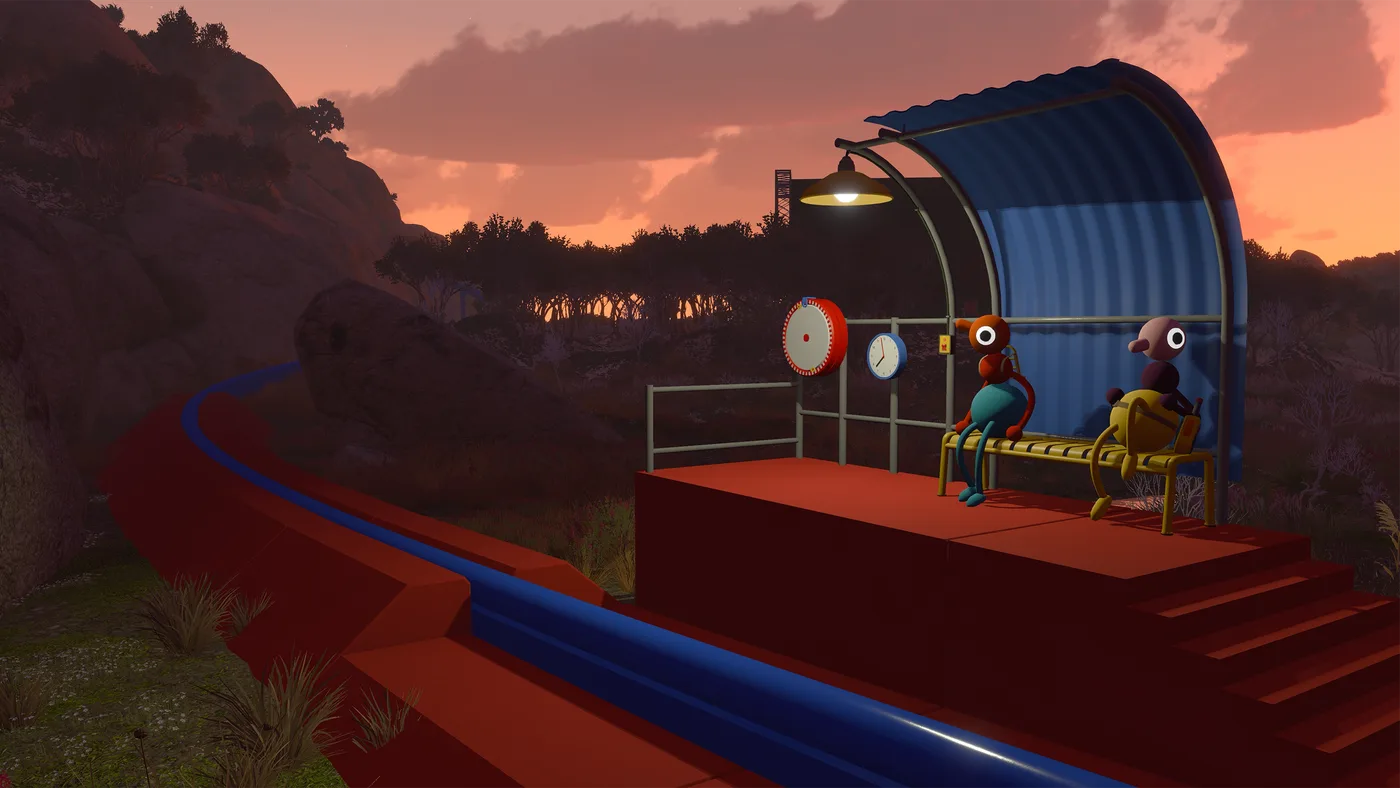
Big Walk is a game about talking, which makes “can I play without a microphone” a fair question to be nervous about. The answer from House House is yes, and the reason is that they did not bolt text chat on — they gave it the same rule set as voice, including the restrictions.
Their wording: Big Walk’s in-game text chat system “has the same features (and intentional limitations) as the in-game voice chat. You can play the whole game that way without missing out.”
Text obeys the voice rules
The two examples House House give are the important ones, because they show that text is inside the simulation rather than above it:
- It is unreadable at distance. “Your text chat won’t be readable when you are far away.” Text has proximity falloff exactly as voice does.
- It is blocked by geometry. Their example is being “on opposite sides of soundproof glass.” Whatever blocks sound blocks text.
- It travels through tools. “Your text chat will work with in-game items like walkie talkies.” A radio extends typed messages the same way it extends speech.
So the puzzle that takes your voice away also takes your typing away. That is the design working as intended: the obstacle is the loss of a communication channel, not the loss of a specific input device.
Voice falloff by tool
Proximity chat drops off with distance. What you carry moves the line.
What you do not lose
Nothing that affects completion. There is no achievement gated on speech, no mechanic documented as voice-only, and no stated difference in range or reliability between the two channels.
Mixing is explicitly fine too — House House say to “use either, or a mixture of voice and text chat, in whatever way works best for you.” A group of five with one text player is a normal configuration, not a handicap.
If speaking or typing quickly is itself the barrier, that is what challenge skipping is for: the host can enable it from the accessibility menu at session start, and it covers any challenge that requires “the ability to hear/read, speak/type, react quickly, or use fine motor skills.”
What changes in practice
Three things are worth planning around if someone in your group is on text.
Speed. Typing is slower than speaking, and Big Walk has moments where a group is moving. The practical fix is the same one that helps everyone: agree on short signals in advance, and lean on gestures for anything urgent — pointing and waving are instant regardless of input method.
Reading while walking. A text message that arrives while you are climbing has to be read. Sitting still for a moment is not a penalty in a game where sitting and watching the sunset is an advertised activity.
Tool priority. Since a walkie-talkie extends typed messages exactly as it extends speech, there is no reason to give radios to voice players first. If anything, a text player benefits slightly more from staying connected at range, because they cannot fall back on shouting.
Setting a group up for a text player
None of this is required, and none of it is a concession — it is the same coordination any group benefits from, made slightly more deliberate.
Agree on short forms. “N of the tower”, “wait”, “found it”. Big Walk gives you no ping system and no shared map, so a group that has agreed on a handful of standard messages moves faster regardless of who is typing.
Hand out a walkie-talkie. Text travels through radios exactly as speech does, and a text player benefits slightly more from staying in contact at range, because they cannot fall back on shouting when the channel degrades.
Use gestures for anything urgent. Pointing and waving are instant and input-agnostic. In a moment where somebody needs to move now, an arm beats a sentence.
Let people stop walking to read. Big Walk has no timer on traversal and House House advertise sitting and watching the sunset as a legitimate activity. Standing still for four seconds to read a message costs nothing.
Where text and voice genuinely differ
Two differences are real and worth naming rather than papering over.
Latency. Typing is slower than speaking, and in the rare moments where the game asks for fast coordination, that gap shows. Challenge skipping exists partly for this: the host can enable it at session start, and it covers any challenge requiring the ability to “speak/type” quickly.
Ambient presence. Voice carries a lot of incidental information — who is nearby, what mood the group is in, whether someone is lost. Text does not idle in the background the same way. A group with a text player usually compensates by checking in slightly more often, which is a habit rather than a workaround.
Why House House built it this way
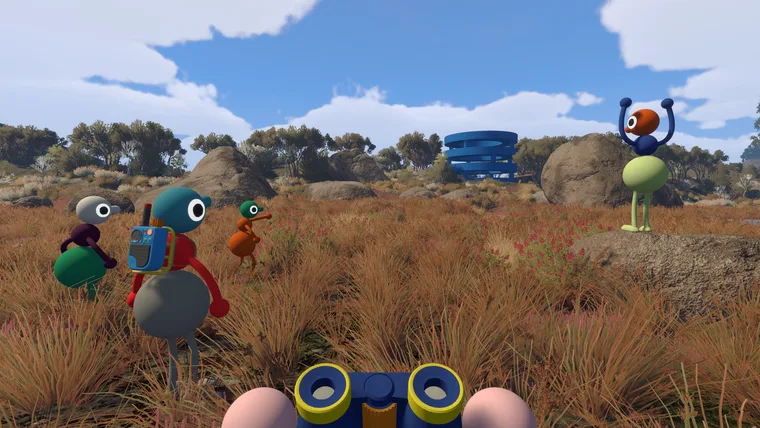
Making text obey the same restrictions as voice was a choice, and an unusual one. The easy version of accessible text chat is a channel that always works — global, readable at any distance, unaffected by walls. That would have made the game playable without a microphone and simultaneously handed text players a tool the voice players do not have.
Instead the studio wrote text into the same simulation. The result is that a text player is solving the same problems as everyone else: they lose contact at range, they get blocked by soundproof glass, and they need a walkie-talkie to reach someone who has walked off. That is what House House mean by “the same features (and intentional limitations)” — the limitations are the point, and removing them would have removed the game.