
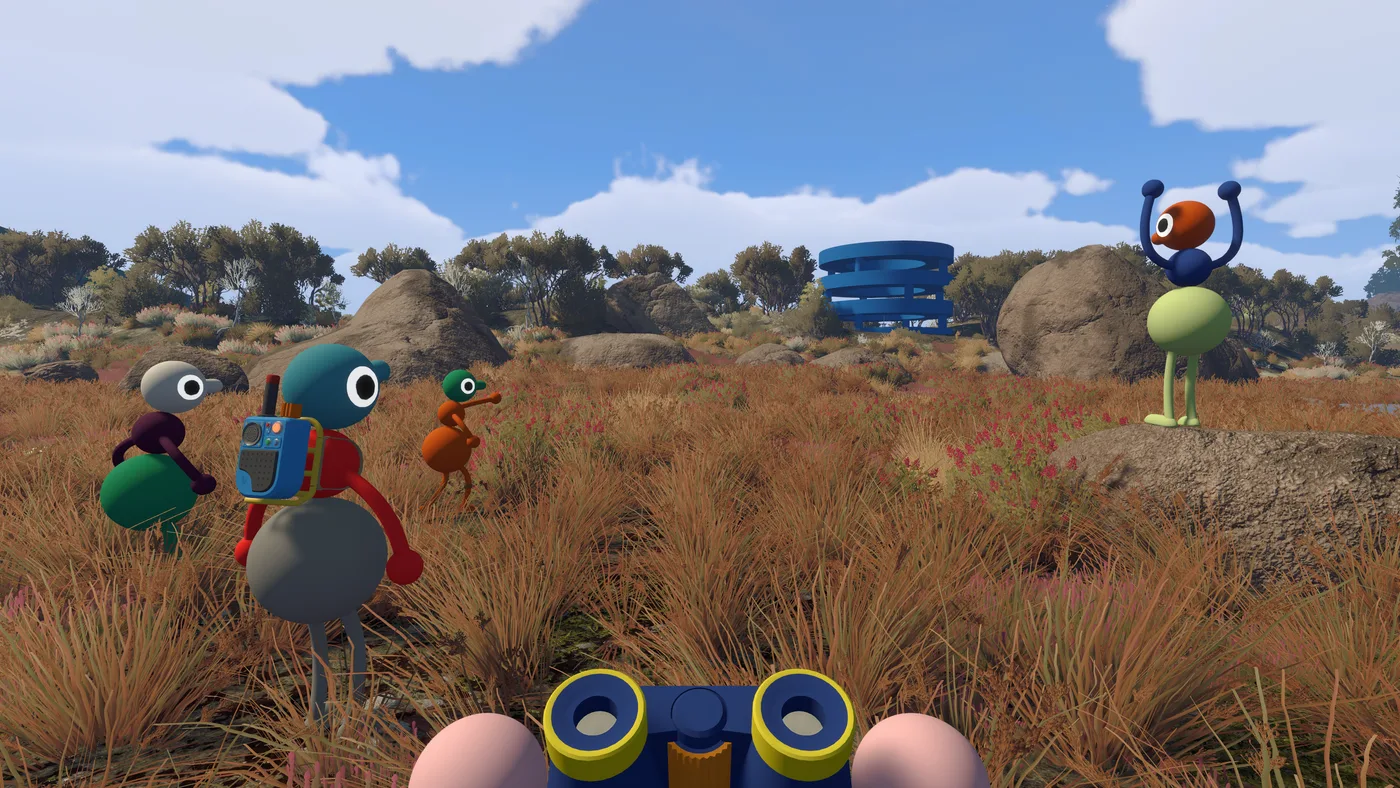
Proximity voice chat is the system Big Walk is built around, not a convenience layer on top of it. House House describe it in one line in their own press material: the system “makes voices fade across distances, echo down corridors, muffle through walls, and crackle through walkie-talkies.” Every one of those four clauses is a mechanic you will use.
The consequence is that where you stand is a communication decision. Splitting up is not free — it costs you the ability to talk — and getting back within earshot is a real objective rather than a formality.
The four behaviours House House named
Distance falloff. Voices fade as players get further apart. This is the baseline, and it is why the group naturally clusters and why a scout going ahead goes quiet.
Corridor echo. Voices echo down corridors. Enclosed geometry carries sound further than open ground does, which makes indoor and tunnel spaces behave differently from the open bush.
Wall muffling. Voices muffle through walls. A wall is not a hard cutoff — you get a degraded version, enough to know someone is talking and often not enough to know what they said.
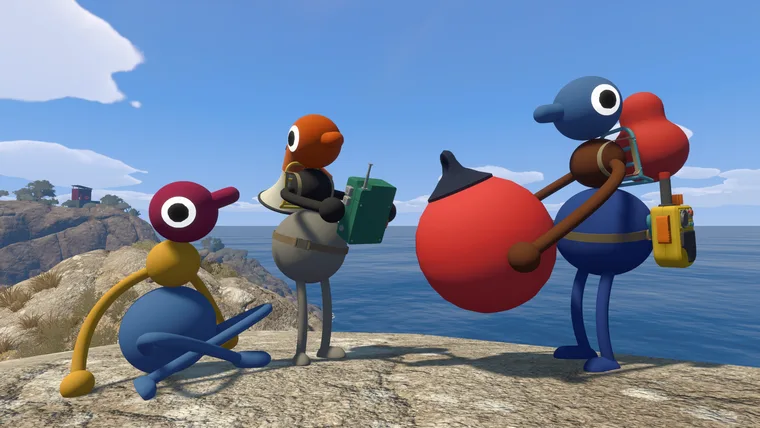
Radio crackle. Voices crackle through walkie-talkies. Transmitted speech is deliberately coloured, which means you can tell by ear whether someone is next to you or on the radio.
Those four are the extent of what has been published. There are no official numbers for falloff distance, no stated echo radius, and no documented list of which surfaces count as walls.
Voice falloff by tool
Proximity chat drops off with distance. What you carry moves the line.
Why external voice chat is not allowed
House House’s position on Discord and equivalents is unusually direct. From the official FAQ: talking to players outside the game is “❌ NOT ALLOWED ❌”, and they “strongly suggest” not playing in the same physical room either.
The reasoning they give is mechanical rather than moral. Big Walk builds situations that “enable or restrict your talking in different, and interesting, ways” — you might end up somewhere you cannot hear each other and have to find another way to communicate. That only works if the game controls the channel. Their own comparison: it would be “like playing charades but everybody gets to talk.”
Nothing enforces it. The game will not stop running or punish you. What happens instead is that whole sections stop making sense, because the obstacle they present has been removed before you encounter it.
What this means for how you spread out
Practical consequences, all following from confirmed behaviour rather than guesswork:
- A scout needs a radio. Sending someone ahead without a walkie-talkie means sending them out of contact. With one, distance stops mattering.
- Walls are worse than distance. Muffling through a wall degrades speech even at close range, so “I can see you through the glass” does not mean “I can hear you.”
- Corridors carry. Sound travels further in enclosed spaces, so an indoor group can coordinate across a longer stretch than an outdoor one.
- Being in the same room in real life defeats all of it. If two players are physically together, they hear each other regardless of where their characters are — which is why House House ask you not to. Separate rooms with separate devices is fine and works normally.
Microphone setup and mute mode
Two settings matter before session one, both under Settings > Audio:
Microphone Activity is the meter that confirms the game hears you. If it does not move when you talk, the game is not receiving input — check the mic works in another application, check it is fully plugged in, and check the physical mute switch on the device or headset.
Mute Mode has a “hold” option. If it is set to hold, you have to hold a button to transmit, which is the most common reason a player believes their microphone is broken when it is not.
If voices sound doubled or echo strangely, that is usually feedback — someone’s microphone is picking up their own speakers. Have each player mute in turn until the doubling stops, then switch that person to headphones.
The audio settings that matter
Big Walk is listed on Steam with Stereo Sound, and the spatial behaviour of the voice system is built on that — direction and distance are both carried by the audio, which is how you locate someone you cannot see.
Two consequences for setup. First, headphones are worth more here than in most games: speakers make direction harder to read and create the feedback loops that produce the doubled-voice problem. Second, if you are the one causing echo for the group, muting when you are not talking is a workaround but headphones are the fix.
The relevant settings all live under Settings > Audio: Volume, Microphone Activity (the input meter), and Mute Mode. That last one decides whether the game uses push-to-talk. It is the single most common cause of a player believing their microphone has failed, and it is worth checking before anything else.
What this system asks of your group
Big Walk’s voice design produces a specific social contract, and it is easier if everyone agrees to it before the first session rather than negotiating it mid-walk:
- No second voice channel. Discord open alongside the game removes the obstacles the game is built on.
- Separate rooms. Two people in the same physical room hear each other regardless of where their characters are, which quietly disables the mechanic for both of them.
- Someone carries the radio. If anyone is going to scout ahead, they need a walkie-talkie, or they are going out of contact.
- Text is equal. A player typing is not a player at a disadvantage, and there is no reason to prioritise voice players when handing out tools.