
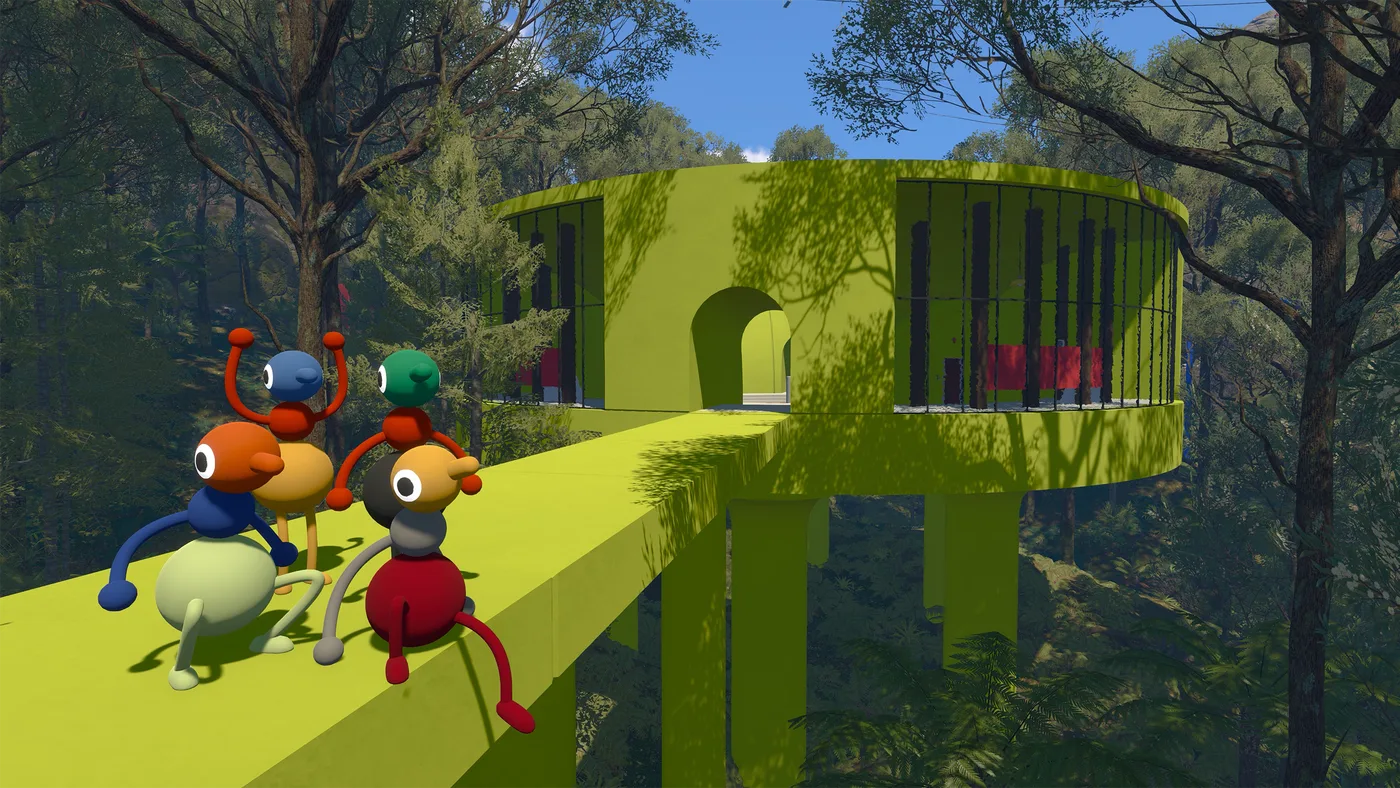
Big Walk’s requirements are unusual in shape: the minimum GPU list goes back to a GTX 750 Ti, but the minimum RAM is 12 GB and the recommended is 16 GB. That points at a game bound by memory and CPU rather than by rendering — consistent with an open world of real terrain populated by flat-coloured characters and a live spatial audio system for up to twelve simultaneous voices.
All figures below are from the Steam store record and the Nintendo eShop listing, checked 5 August 2026.
Windows
| Spec | Windows minimum | Windows recommended |
|---|---|---|
| OS | Windows 10 (64-bit) | Windows 11 (64-bit) |
| Processor | Intel Core i7-7700K or AMD Ryzen 5 1600X | Intel Core i5-10600K or AMD Ryzen 7 3700X |
| Memory | 12 GB | 16 GB |
| Graphics | NVIDIA GeForce GTX 750 Ti 2 GB / AMD Radeon R7 370 2 GB / Intel Arc A380 6 GB | NVIDIA GeForce GTX 1070 8 GB / AMD Radeon RX 5600 XT 8 GB / Intel Arc A750 8 GB |
| Spec | macOS minimum | macOS recommended |
|---|---|---|
| OS | macOS 15 | macOS 15 |
| Processor | Apple Silicon M1 or newer | Apple Silicon M3 or newer |
| Memory | 16 GB | 16 GB |
Both rows require a 64-bit processor and operating system. The recommended row moves from Windows 10 to Windows 11, but the meaningful jumps are RAM (12 → 16 GB) and GPU (750 Ti → GTX 1070 class).
One rule that has nothing to do with your own experience and everything to do with your group’s: if you are the host, House House state that a low frame rate on your machine can cause network problems for everyone in the session. A host on minimum spec should turn settings down before the first session rather than after somebody complains about lag.

macOS
| Minimum | Recommended | |
|---|---|---|
| OS | macOS 15 | macOS 15 |
| Processor | Apple Silicon M1 or newer | M3 or newer |
| Memory | 16 GB RAM | 16 GB RAM |
Apple Silicon only — no Intel Mac configuration is listed. macOS 15 is the floor on both rows, and 16 GB of RAM is the minimum rather than the recommendation, which is 4 GB above the Windows floor.
Note that macOS is sold through two storefronts and they are not equivalent: the Mac App Store build has no Game Center support, so it shows no friends list. See Big Walk on Mac.
Consoles
| Nintendo Switch 2 download | 3.9 GB |
| Nintendo Switch 2 online play | Requires Nintendo Switch Online |
| PlayStation 5 online play | Requires PlayStation Plus |
Neither console publishes a separate performance tier. Big Walk is online-only on both, so the subscription is a hard requirement rather than a multiplayer add-on.
If you are below minimum
House House publish a specific tuning order, and it is worth following in sequence rather than turning everything down at once:
- Settings > Graphics > Render Scale — lower it first. This reduces GPU load.
- Settings > Graphics > Quality — lower it second. This reduces CPU and GPU load.
- Raise Render Scale back up gradually until it stops being smooth, then step back once.
Their stated purpose for that sequence is balancing CPU against GPU, which is why it ends by going back up rather than leaving everything at minimum.
Two related settings: Field of View (Settings > Graphics) costs performance when raised but reduces motion sickness for some players, and it is worth deciding which you need more. And if the whole session is stuttering rather than just your machine, check the host’s frame rate before anyone touches a router — see troubleshooting.
What the numbers imply
The Windows minimum row is unusual in shape and worth reading rather than skimming.
GPU: a GTX 750 Ti, 2 GB. That is a 2014 card. A modern open-world game asking for it as a floor is telling you the rendering budget is small — which matches what the game looks like: real terrain, flat-shaded characters, and saturated untextured structures.
RAM: 12 GB minimum, 16 GB recommended. That is the demanding figure, and it is where a marginal machine will actually struggle.
CPU: an i7-7700K or Ryzen 5 1600X minimum. Also high relative to the GPU floor.
The combination points at a game bound by simulation and memory rather than pixels — an open world plus a live spatial audio system mixing up to twelve voices with distance, occlusion and reverb. That is CPU work, and it is why lowering Quality (which House House say reduces both CPU and GPU load) helps where lowering resolution alone does not.
The host’s requirements are different
One rule sits outside the spec table and matters more than any of it: if you are hosting, your frame rate is everyone’s network quality.
House House state this directly — “a low graphics framerate, or the host having a low graphics framerate, can cause network issues,” and “if all players on a game are experiencing network issues, it may be that the host is having network troubles.”
So a group where one machine is at minimum spec should not have that machine host, or should have it host at deliberately low settings. Their alternative suggestion is the simplest fix available: get a different player to host.
Since the host also holds the only save, this cannot be swapped casually mid-run — which makes it one more reason to settle the host question before the first session rather than after.